
The new EU framework for materials in contact with drinking water, created under the Drinking Water Directive (EU) 2020/2184 and its implementing acts, introduces a risk-based testing system. This ensures that products are assessed according to their real impact on drinking water quality, rather than applying the same testing burden to every material.
The Coordination Group of Notified Bodies (NB Coordination Group) has published guidance clarifying how to use Risk Groups (RGs) and the Conversion Factor (CF) when assessing products. These two concepts form the backbone of conformity assessment under Decision 2024/368 (test methods) and Regulation 2024/370 (conformity procedures). This approach is based on the 4-MS initiative.
Risk groups: The Key
Risk groups serve a simple and practical purpose: they determine the risk-based approach the DWD applies. They define the testing obligations and the required conformity assessment module under Regulation 2024/370. In other words, the risk group determines both the extent of testing and the certification pathway.
For non-metallic materials, four risk groups (RG1–RG4) are defined. Products with a high conversion factor (CF ≥ 4 d/dm) fall into RG1, representing the highest potential impact on drinking water. These require the most demanding testing, often on the final product itself, and follow the stricter Module B + D pathway.
Conversely, small parts with very low CF values may fall into RG4, where testing is reduced and lighter pathways (Module B + C) apply.
For assembled products, each component is classified individually. If a component contributes more than 10% of the total wetted surface, it is treated as a full fitting (Group B); below that it may fall into Groups C or D. This determines what is tested (product, component, or test piece) and which conformity module applies.
Metallic materials are an exception. Since alloys must be fully assessed before being added to the EU positive list, no additional risk group applies. Product group classification alone (pipe, fitting, ancillary) determines conformity procedures. For cementitious and enamel materials, RG1–RG3 behave similarly; only very small RG4 parts qualify for reduced testing.
Risk-based approach
The new Drinking Water Directive applies a risk-based approach to testing and conformity assessment. Instead of treating all products equally, the system recognises that different components contribute differently to potential contamination.
Products and components are divided into product groups, mostly based on conversion factors (CFs). CFs translate migration results into concentrations expected at the tap.
For metallic materials, classification is determined only by product groups. Pipes are allocated 100% surface contribution; fittings inside buildings receive 10%; smaller components are allocated 1% or less.
For non-metallic materials, Decision 2024/368 defines CF tables. Migration testing is performed under worst-case laboratory conditions, and results (μg/dm²·d) are converted into real-world expected concentrations using the CF.
Product groups range from A1–A3 pipes to B1–B3 fittings, to smaller components (C–D), and storage systems (E–G). The smaller and closer to the consumer, the higher the CF.
Basic formula
The following formula is used:
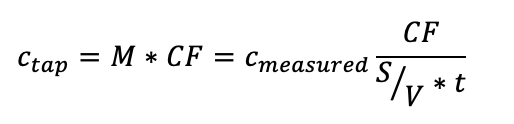
Where:
- M: Migration rate according to EN 12873-1/-2 or EN 14944 in μg/(dm²·d)
- CF: Conversion factor (d/dm)
- cmeasured: Concentration measured in migration water (μg/L)
- S/V: Surface-to-volume ratio during testing (dm⁻¹)
- t: Contact time of the migration period (days)
Summation of wetted surface fractions
When assembled products contain multiple components, their wetted areas must be summed by material type. If small polymeric parts exceed 10% of the total wetted surface, they are reclassified as fittings. Special rules apply to heat exchangers and similar ancillaries.
For polymers, “same (main) polymer” means made of the same monomers (e.g., PE, PVC). For other materials, it refers to identical entries on the EUPL.
Metallic: The exception
For metallic final materials or components there is no risk group. They are classified according to Decision 2024/365 Annex 2 Table 2 into product groups.
| Product Group | Examples | Assumed Surface Contact |
|---|---|---|
| A | Pipes | 100% |
| B | Fittings, ancillaries in buildings | 10% |
| C (1) | Components of B where sum < 10% | 1% |
| C (2) | Fittings/ancillaries in mains with permanent flow | 1% |
| D | Components in C(2) assemblies | < 0.1% |