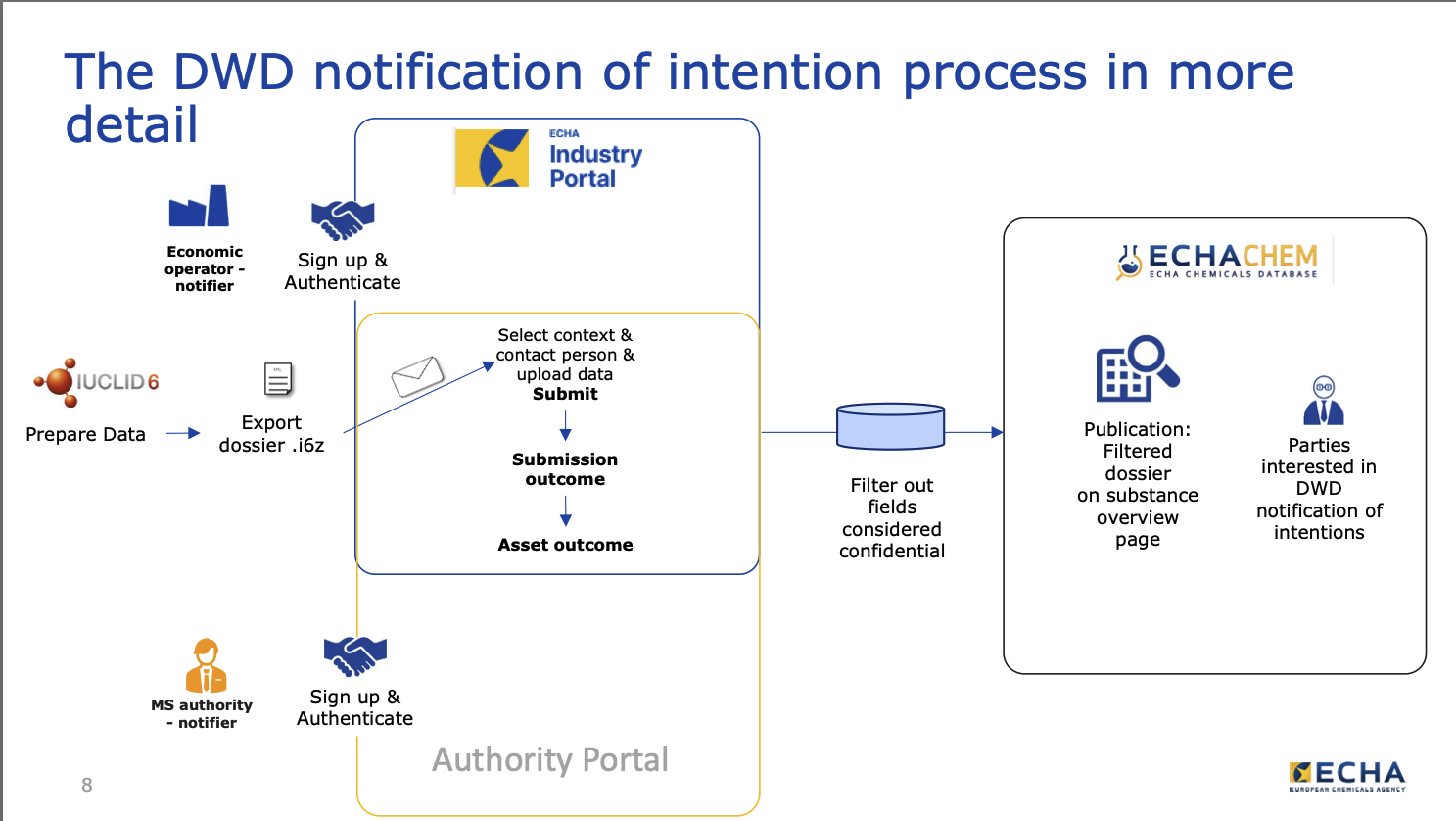
Under the Drinking Water Directive (DWD), any company that wants a starting substance, metallic composition, enamel/inorganic composition or organic cementitious constituent to be placed on the European Positive List (EUPL) — including renewals — must follow a two-step process: first a Notification of Intention (NoI), and then the full application. The NoI is not a formality: it is a mandatory prerequisite before ECHA will accept any application for inclusion, review (renewal or modification), or removal of an entry from the EUPL.
Article 2 of Regulation (EU) 2024/369 states:
The NoI serves three purposes: (1) informing ECHA, (2) creating transparency, and (3) signalling to other potential applicants that a dossier is being prepared — enabling coordination or joint applications. ECHA recommends submitting an NoI as early as possible, ideally 12 months before the planned application date.
An NoI always concerns one individual entry: a single starting substance, a single metallic composition, a single organic cementitious constituent, or a single enamel/ceramic/inorganic composition. New group entries cannot be notified; however, you may submit an NoI for an individual substance that falls within an existing group on the first EUPL.
Once submitted, the NoI is valid for 12 months. If the full application is not filed within that timeframe, the NoI expires automatically and a new NoI must be filed. Therefore, applicants should time their NoI realistically — not too early, not too late.
What information must be included in a Notification of Intention?
ECHA’s guidance groups the required content into four blocks:
- Intended application type
- Identification and composition of the notified entry
- Intended use(s)
- Notifier and contact details
1. Intended application type
In the IUCLID dossier header, you must indicate whether the future application is for:
- Inclusion of a new entry in the EUPL
- Review of an existing entry (including modifications)
- Removal of an existing entry
You must also select the material type (organic, metallic, cementitious or inorganic) and, for reviews/removals, provide the relevant EUPL 4-digit number. You then indicate the planned application submission date, which must fall within the 12-month validity of the NoI.
2. Identification and composition of the notified entry
IUCLID Section 1 must identify the entry as it is intended to appear in the EUPL. This includes:
- Name of the notified entry (IUPAC name of the reference substance)
- Other identifiers (EC number, CAS number, if available)
- Type (mono-constituent, multi-constituent, UVCB, polymer, or “other”)
- Physical state, including whether it is a nanoform
Section 1.2 requires the chemical composition:
- Use legal entity composition in most cases (boundary composition is only for new metallic composition categories).
- List all constituents with concentration ranges (polymers/pre-polymers do not require ranges).
- For metallic compositions, list impurities ≥ 0.02% w/w with maximum concentrations.
Each constituent and reported impurity must have its own reference substance in IUCLID.
3. Intended use(s)
Section 2 requires a concise description of intended uses. Recommended elements:
- Material category (organic/metallic/cementitious/inorganic)
- For metallic entries: composition category and product groups A–D
- For organic starting substances and organic cementitious constituents: technical function (monomer, additive, admixture, etc.)
If applicable, separate intended-use records may be created for different categories or product groups.
4. Notifier and contact details
The NoI must clearly identify the notifier (legal entity name and contact email), submitted through the ECHA Industry Portal. If a third-party representative is used, their details will be published instead of the company’s.
Need support preparing an NoI? Contact us — we are happy to help.
Further guidance can be found here: ECHA Guidance – Volume IV (Notification of Intention)
Useful ECHA visual overview: